
Before there was a community radio sector, there was a campaign for the airwaves. More than thirty years later, the stations that campaign created are still the place many KwaZulu-Natal residents turn to for news, public information and conversation in the language they speak at home.
It started here
The National Community Radio Forum (NCRF) was established in Orlando, Soweto, in December 1993. In its own presentation to Parliament, the Forum describes itself as a cornerstone of the “freedom of the airwaves” campaign that led to the creation of ICASA and the Media Development and Diversity Agency (MDDA). That campaign produced the first community radio licences, and the first of them were issued to Radio Pietermaritzburg in KwaZulu-Natal and Radio Bush in the Western Cape.
NCRF-KZN grew out of that national movement as the Forum’s provincial affiliate. Since 2007 it has coordinated and represented licensed community stations across the province.
A province with deep roots
ICASA’s World Radio Day statement in February 2026 put the number of licensed community broadcasting services in South Africa at 206. KwaZulu-Natal accounts for 27 of them, the fourth-highest provincial total after Gauteng (38), Limpopo (29) and the Western Cape (28).
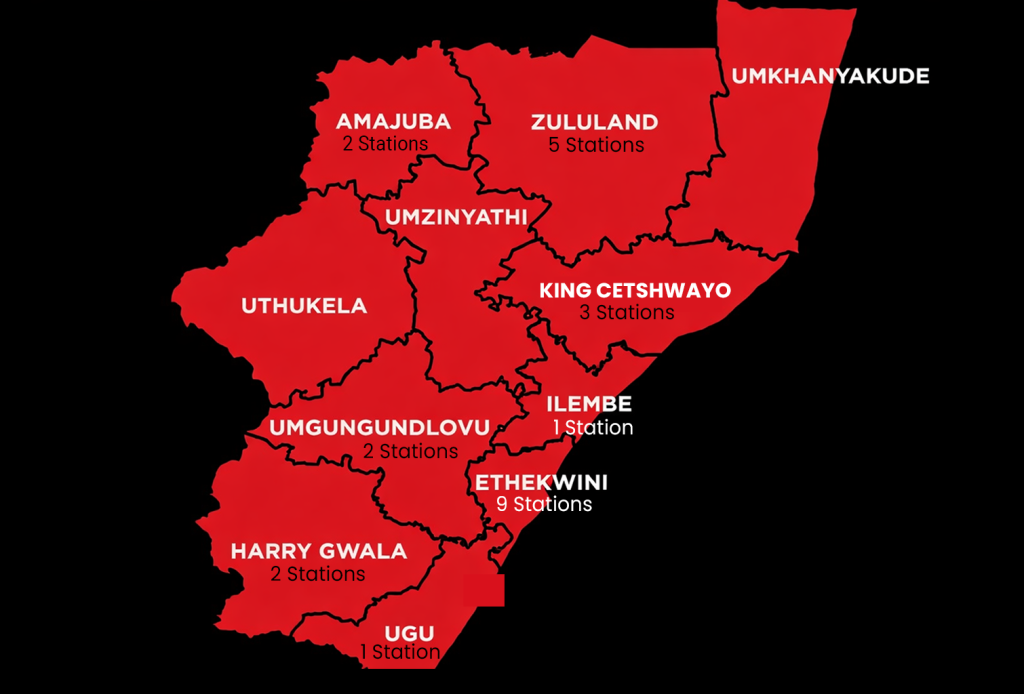
Tied to a place and a language
A community radio licence is not simply permission to broadcast; it binds a station to a community. Licence schedules name the area a station must serve and the languages it must use. The licence of Umgungundlovu Community Radio, for example, requires it to serve the uMgungundlovu District and to broadcast 81% in isiZulu, 16% in English, 2% in other languages and 1% in Afrikaans. It also commits the station to a daily news allocation in which most of the content must be local.
The same principle shows up across the province. Vibe FM, licensed in April 2007 to serve KwaMashu and surrounding areas, broadcasts 60% in isiZulu and 40% in English. Ugu Youth Radio, supported by the MDDA, broadcasts in isiZulu, isiXhosa and English, the languages its community chose.
More than music
These conditions are what make community radio different from a commercial playlist. Because a station answers to the people it serves, it is often where municipal notices, health campaigns, school announcements and local events are heard first, and where listeners can phone in to be heard themselves. For government departments, municipalities and development agencies, that hyper-local reach is difficult to replicate any other way.
The sustainability test
None of this is free. Speaking in 2024, the MDDA’s chief executive described sustainability as a major challenge for the sector and identified its heavy dependence on the agency as the biggest problem. She noted that MDDA funding is limited and can support only a limited number of projects each year, and that she wants to develop new digital funding models and rebuild private-sector partnerships. Power cuts have added another cost: some stations have applied for generators and solar equipment to stay on air.
Seen that way, advertising and partnership spend with community stations is more than a media buy. It is a contribution to keeping a local, accountable information service running.
What comes next
The theme of World Radio Day 2026 was “Radio and Artificial Intelligence”, a reminder that the medium is changing alongside the technology around it. Community stations will need new skills and new revenue models to keep up, while holding on to what sets them apart: they are local, they are accountable to their listeners and they speak in the languages of their communities.
That is the work NCRF-KZN exists to support, through advocacy, coordination, capacity building and by connecting organisations to the audiences these stations serve.
Sources
- ICASA – “ICASA commemorates World Radio Day” media release, 13 February 2026
- National Community Radio Forum – “State of Community Radio in South Africa”, presentation to Parliament (PMG)
- ICASA – Umgungundlovu Community Radio annual compliance report 2018/2019 (licence conditions)
- South African Government – Vibe FM studio unveiling media advisory (Vibe FM language split and licensing)
- SAnews – “New hi-tech equipment for KZN youth station”, 29 September 2019 (Ugu Youth Radio languages and MDDA support)
- RedTech – “Innovative funding empowers South Africa’s community radio”, 1 October 2024 (interview with the MDDA CEO)
Work with the network
NCRF-KZN connects government, municipalities and brands to licensed community stations across KwaZulu-Natal.